How To Download Java 8 Standard Edition On Mac UPDATED
How To Download Java 8 Standard Edition On Mac
How to Install JDK 17 (on Windows, macOS & Ubuntu) and Get Started with Java Programming
The Coffee Development Kit (JDK), officially named "Java Platform Standard Edition" or "Coffee SE", is needed for writing and running Java programs.
JDK Variants
There are few variants of JDK:
- OpenJDK: Currently, the "OpenJDK" adult past Oracle and the Java community (@ https://openjdk.java.net/) provides a free and open-source JDK official reference implementation.
- OracleJDK: This commodity is based on the "OracleJDK" (@ https://www.oracle.com/java/) (due to legacy), which is costless for personal and development employ merely no longer costless for commercial use.
JDK Versions
Reference: "Java Version History" @ https://en.wikipedia.org/wiki/Java_version_history.
- JDK Blastoff and Beta (1995): Sun Microsystem appear Java in September 23, 1995.
- JDK one.0 (January 1996): Originally called Oak (named afterwards the oak tree outside James Gosling's part). Renamed to Java 1 in JDK ane.0.two.
- JDK 1.ane (Feb 1997): Introduced AWT event model, inner class, JavaBean, JDBC, and RMI.
- J2SE ane.two (JDK 1.2) (December 1998): Re-branded every bit "Java ii" and renamed JDK to J2SE (Java two Standard Edition). Likewise released J2EE (Java 2 Enterprise Edition) and J2ME (Java 2 Micro Edition). Included JFC (Java Foundation Classes - Swing, Accessibility API, Coffee 2nd, Pluggable Wait & Feel, and Elevate & Drib). Also introduced Drove Framework and JIT compiler.
- J2SE 1.iii (JDK 1.three) (May 2000): Introduced Hotspot JVM.
- J2SE 1.four (JDK ane.four) (Feb 2002): Introduced
assertstatement, non-blocking IO (nio), logging API, image IO, Java webstart, regular expression (regex) support. - J2SE 5.0 (JDK 5) (September 2004): Officially called 5.0 instead of 1.5 (by dropping the one.). Introduced generics, autoboxing/unboxing, annotation, enum, varargs, for-each loop, static import. Run across "JDK v New Features".
- Java SE 6 (JDK 6) (December 2006): Renamed J2SE to Java SE (Java Platform Standard Edition). No new language features. See "JDK 6 New Features".
- Java SE 7 (JDK 7) (July 2011): Showtime version subsequently Oracle purchased Lord's day Microsystem - aslo called OracleJDK. Introduced Strings in
switchargument, Binary integer literals, allowing underscores in numeric literals, improved type inference for generic instance creation (or diamond operator<>), Communicable multiple exception types and rethrowing exceptions with improved type checking. See "JDK 7 New Features". - Java SE viii LTS (JDK eight) (March 2014): Included support for Lambda expressions, default and static methods in interfaces, improved collection, and JavaScript runtime. Also integrated JavaFX graphics subsystem. Come across "JDK 8 New Features".
- Java SE 9 (JDK ix) (September 21, 2017): Introduced modularization of the JDK (
module) nether project Jigsaw, the Java Crush (jshell), and more. See "JDK 9 New Features". - Java SE 10 (18.3) (JDK 10) (March 2018): Introduced
varfor type inference local variable (like to JavaScript). Introduced time-based release versioning with two releases each year, in March and September, denoted asYY.M.Removed native-header generation tooljavah. See "JDK 10 New Features". - Coffee SE eleven LTS (xviii.9) (JDK 11) (September 2018): Extended
varto lambda expression. Standardize HTTP client injava.net.http. Support TLS 1.three. Clean upwardly the JDK and the installation package (removed JavaFX, JavaEE, CORBA modules, deprecated Nashorn JavaScript engine). OracleJDK is no longer costless for commercial utilise, but OpenJDK is all the same free. See "JDK 11 New Features". - Coffee SE 12 (xix.3) (JDK 12) (March 2019): Switch Expression (preview). Encounter "JDK 12 New Features".
- Java SE 13 (19.ix) (JDK 13) (September 2019): Switch Expression (preview), Multi-line Text Cake (preview). See "JDK xiii New Features".
- Java SE fourteen (20.3) (JDK 14) (March 2020): Records (preview)
- Java SE xv LTS (twenty.9) (JDK xv) (September 2020):
- Java SE 16 (JDK 16) (March 2021):
- Java SE 17 LTS (JDK 17) (September 2021):
- Java SE 18 (JDK 18) (March 2022):
"JDK" or "JRE"?
JRE (Java Runtime), which include a Java Virtual Machine and core libraries, is needed for running Java programs. JDK (Java Development Kit), which includes JRE plus the development tools (such as compiler and debugger), is need for writing too as running Java programs. In other words, JRE is a subset of JDK. Since y'all are supposed to write Coffee Programs instead of but running Java programs, you lot should install JDK, which includes JRE.
How To Install JDK on Windows
Stride 0: United nations-Install Older Version(due south) of JDK/JRE
I recommend that you install simply the latest JDK. Although yous tin install multiple versions of JDK/JRE concurrently, it is messy.
If yous accept previously installed older version(s) of JDK/JRE, un-install ALL of them. Goto "Control Panel" ⇒ (optional) "Programs" ⇒ "Programs and Features" ⇒ Un-install ALL programs begin with "Java", such as "Java SE Development Kit ...", "Coffee SE Runtime ...", "Coffee X Update ...", and etc.
Footstep 1: Download JDK
- Goto JDK (or Java SE) download site @ https://www.oracle.com/java/technologies/javase-downloads.html.
- Under "Java SE Development Kit 17.0.{x} downloads".
- Select "Windows" ⇒ Download the "x64 Installer" (eastward.chiliad., "
jdk-17_windows-x64_bin.exe" - about 152MB).
Stride two: Install JDK
Run the downloaded installer. Accept the defaults and follow the screen instructions to complete the installation. By default, JDK is installed in directory "C:\Plan Files\Java\jdk-17.0.{x} ", where {10} denotes the running "update number" starting from i.
Launch "File Explorer". Navigate to "C:\Program Files\Java" to inspect this directories. Take note of your JDK Installed Directory jdk-17.0.{ten} , in particular, the update number {10} .
I shall refer to the JDK Installed Directory equally <JAVA_HOME> , hereafter, in this article (respective to environment variable %JAVA_HOME% in Windows or $JAVA_HOME in Unix/macOS).
Footstep 3: (SKIP for JDK 17, sixteen, xvi - kept for abyss) Include JDK's "bin" Directory in the PATH
Windows' Command Prompt (CMD) searches the current directory and the directories listed in the PATH environment variable for executable programs.
JDK's programs (such equally Java compiler "javac.exe" and Java runtime "java.exe") reside in the sub-directory "bin" of the JDK installed directory. JDK's "bin" needs to be added into the PATH.
Prior to JDK 15, you demand to explicitly add JDK's "bin" into the PATH. Starting from JDK 15, the installation procedure adds the directory "C:\Program Files\Common Files\Oracle\Coffee\javapath" to the PATH. The "javapath" directory is a link to "javapath_target_xxxxxx", which contains a copy of the following JDK programs:
-
java.exe: Java Runtime -
javac.exe: Coffee Compiler -
javaw.exe: Java Runtime for Windows Console-less -
jshell.exe: Java Command-line Shell (since JDK ten) - a Read-Evaluate-Print Loop (REPL) which evaluates declarations, statements, and expressions as they are entered and immediately shows the results.
Link is used and so that you lot can keep multiple copies (versions) of JDK.
To edit the PATH surroundings variable in Windows ten:
- Launch "Control Panel" ⇒ (Optional) "Organization and Security" ⇒ "Arrangement" ⇒ Click "Advanced organisation settings" on the left pane.
- Switch to "Advanced" tab ⇒ Click "Environment Variables" button.
- Nether "System Variables" (the bottom pane), scroll downwards to select variable "Path" ⇒ Click "Edit...".
- For Newer Windows 10:
Yous shall see a TABLE listing all the existing PATH entries (if not, goto next stride). Click "New" ⇒ Click "Browse" and navigate to your JDK's "bin" directory, i.eastward., "c:\Program Files\Java\jdk-xv.0.{10}\bin", where{x}is your installation update number ⇒ Select "Move Up" to move this entry all the way to the TOP. - For Older Windows 10 (Time to change your computer!):
(Caution: Read this paragraph 3 times before doing this step! Don't push "Apply" or "OK" until you are 101% sure. There is no UNDO!!!)
(To be SAFE, copy the content of the "Variable value" to Notepad before irresolute it!!!)
In "Variable value" field, APPEND "c:\Program Files\Java\jdk-15.0.{ten}\bin" (where{x}is your installation update number) IN Front end of all the existing directories, followed by a semi-colon (;) to separate the JDK'southward bin directory from the rest of the existing directories. DO NOT DELETE any existing entries; otherwise, some existing applications may non run.Variable proper name : PATH Variable value : c:\Plan Files\Java\jdk-15.0.{x}\bin; [do not delete exiting entries...]
Yous demand to re-started CMD for the new surroundings settings to take consequence.
Step 4: Verify the JDK Installation
Launch a CMD via one of the post-obit means:
- Click "Search" button ⇒ Type "cmd" ⇒ Choose "Control Prompt", or
- Correct-click "Start" button ⇒ run... ⇒ enter "cmd", or
- Click "Beginning" push button ⇒ Windows System ⇒ Control Prompt
Issue the post-obit commands to verify your JDK installation:
- (Skip for JDK 17, 16, xv) Issue "
path" command to list the contents of thePATHenvironment variable. Bank check to brand sure that your JDK'southward "bin" is listed in thePATH.path PATH=c:\Plan Files\Coffee\jdk-{xx.y.z}\bin;other entries... - Issue the following commands to verify that JDK/JRE are properly installed and display their version:
javac -version javac 17.0.1 coffee -version coffee version "17.0.1" 2021-10-xix LTS Java(TM) SE Runtime Environment (build 17.0.ane+12-LTS-39) Coffee HotSpot(TM) 64-Bit Server VM (build 17.0.i+12-LTS-39, mixed way, sharing)
Step five: Write a Hello-World Java Plan
- Create a directory to keep your works, e.g., "
d:\myProject" or "c:\myProject". Exercise NOT save your works in "Desktop" or "Documents" as they are hard to locate. The directory name shall not comprise bare or special characters. Use meaningful only short proper noun as information technology is easier to type. - Launch a programming text editor (such as TextPad, NotePad++, Sublime Text, Atom). Brainstorm with a new file and enter the post-obit source code. Save the file as "
Hi.java", under your work directory (due east.thou.,d:\myProject).public class Hello { public static void main(String[] args) { System.out.println("How-do-you-do, globe!"); } }
Pace 6: Compile and Run the Howdy-World Java Program
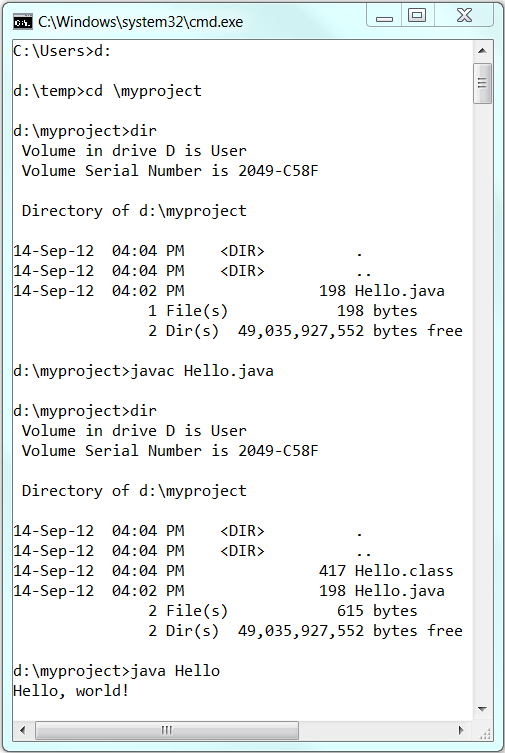
To compile the source code "Hello.java":
- Starting time a CMD Vanquish (Search ⇒ enter "cmd" ⇒ select "Command Prompt").
- Set the Current Bulldoze to the drive where you saved your source file "
Hello.java".
If you use drive "c", skip this stride.
Else if you use drive "d", enter "d:" as follow:d: D:\30> - Set up the Electric current Working Directory to the directory that you saved your source file via the
cd(Modify Directory) command. For example, suppose that your source file is saved in directory "myProject".
cd \myProject D:\myProject> - Result a
dir(List Directory) command to ostend that your source file is nowadays in the current directory.dir ...... xx-xxx-xx 20:xx PM 277 Hello.java ...... - Invoke the JDK compiler "
javac" to compile the source code "Hullo.coffee".javac Hello.coffee
The compilation is successful if the command prompt returns. Otherwise, error messages would be shown. Correct the errors in your source file and re-compile. Check "Common JDK Installation Errors", if y'all encounter problem compiling your program. - The output of the compilation is a Java class called "
Hello.class". Issue adir(Listing Directory) command once more to check for the output.dir ...... 20-30-xx xx:xx PM 416 Hello.form xx-30-xx xx:xx PM 277 Hello.java ......
To run the program, invoke the Java Runtime " java ":
java How-do-you-do Hello, earth! Everything that can maybe go incorrect will go wrong: Read "JDK Installation Common Errors".
Footstep vii: (For Advanced Users Only) JDK's Source Lawmaking
Source code for JDK is provided and kept in "<JAVA_HOME>\lib\src.zip" (or "<JAVA_HOME>\src.null" prior to JDK 9). I strongly recommend that yous to go through some of the source files such every bit "String.coffee", "Math.coffee", and "Integer.java", under "java\lang", to acquire how experts plan.
How to Install JDK on macOS
Step 1: Check if JDK has been Pre-Installed
To check if JDK has been installed, open a "Terminal" (Search "Terminal"; or Finder ⇒ Go ⇒ Utilities ⇒ Terminal) and consequence this command:
javac -version
- If a JDK version number is returned (eastward.chiliad.,
JDK x.x.x), and so JDK has already been installed. If the JDK version is prior to 11, proceed to Step 2 to install the latest JDK; otherwise, proceed to "Stride 3: Write a Hello-world Coffee program". - If message "control not plant" appears, JDK is NOT installed. Keep to the "Pace 2: Install JDK".
- If message "To open javac, you demand a Java runtime" appears, select "Install" and follow the instructions to install JDK. Then, keep to "Footstep 3: Write a Hello-earth Java programme".
Pace two: Download JDK
- Goto JDK (or Java SE) download site @ https://www.oracle.com/coffee/technologies/javase-downloads.html.
- Nether "Java SE Evolution Kit 17.0.{x} downloads".
- Select "macOS" ⇒ Download the "x64 Installer" (e.k., "
jdk-17_windows-x64_bin.exe" - almost 152MB). - Under "Oracle JDK", click "JDK Download".
- Download the "x64 DMG installer" (e.chiliad,
jdk-17_macos-x64_bin. dmg- nearly 168MB (I am bold that yous are using Intel processor, non ARM processor. Mac is moving to ARM processor.)
Step three: Install JDK/JRE
- Double-click the downloaded Disk Image (DMG) file. Follow the screen instructions to install JDK/JRE.
- Squirt the DMG file.
- To verify your installation, open up a "Terminal" and issue these commands.
javac -version javac 17.0.{ten} java -version java version "17.0.{10}" ...... which javac /usr/bin/javac which coffee /usr/bin/java
Step three: Write a Hello-World Java Programme
- Create a directory chosen "
myProject" under your "home" directory (Launch "Finder" ⇒ "Go" ⇒ "Home"; Select "File" ⇒ "New Folder" ⇒ "myProject").
In macOS/Unix, the "home" directory of the current user can be referenced as "~". Hence, this new directory can exist referenced every bit "~/myProject". - Utilise a programming text editor (such as Sublime Text or Atom) to input the following source lawmaking and save as "
How-do-you-do.coffee" under the directory "~/myProject".
(If y'all use macOS's default text editor "TextEdit" (NOT recommended), you need to open a new file ⇒ choose "Format" ⇒ "Brand Plain Text" ⇒ Enter the source code ⇒ Save as "Howdy.java".)public class Hello { public static void main(Cord[] args) { Organisation.out.println("Hello, earth from Mac!"); } }
Step 4: Compile and Run the How-do-you-do-Globe Coffee Plan
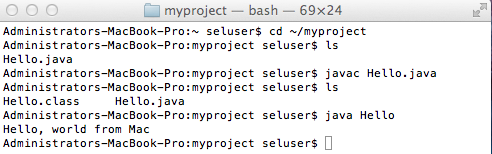
- To compile the source code "
How-do-you-do.java", open up a new "Concluding" ("Go" ⇒ "Utilities" ⇒ "Terminal") and issue these commands (as illustrated):cd ~/myProject ls Hello.java ...... javac Hello.java ls Howdy.class Hello.coffee ......
- To run the Hello-world, invoke the Java Runtime "
java" as follows:coffee Hello Howdy, globe from Mac!
How to Install JDK (fifteen) on Ubuntu
Nosotros shall try both the OpenJDK (free and open-source) and the Oracle JDK (free for personal and development, simply not complimentary for production).
Step 0: Check if JDK has already been Installed
Open a Terminal and outcome this command:
$ javac -version
If a JDK version number (eastward.g., "javac x.ten.x") appears, JDK has already been installed. You lot can skia the installation and goto Open2.
Step 1a: Install OpenJDK
[TODO]
To remove OpenJDK, issue control:
$ sudo apt-go purge openjdk-\*
Step 1b: Install Oracle JDK
- Goto Oracle JDK (Java SE) download site @ https://www.oracle.com/coffee/technologies/javase-downloads.html ⇒ Under "Oracle JDK", click "JDK Download" ⇒ Select "Linux x64 Compressed Archive" package (e.yard., "
jdk-15.0.{x}-linux-x64_bin.tar.gz" - 179MB). The tarball will be downloaded in directory "~/Downloads", past default. - Nosotros shall install JDK under "
/usr/local/java" (or Ubuntu's default JDK directory/usr/lib/jvm; or/opt/java). First, create a directory "coffee" under "/usr/local". Open up a Terminal and issue these commands:$ cd /usr/local $ sudo mkdir java
Extract the downloaded package (Check your downloaded filename!)$ cd /usr/local/java $ sudo tar xzvf ~/Downloads/jdk-fifteen.0.{x}-linux-x64_bin.tar.gzJDK shall be extracted in a folder "/usr/local/java/jdk-15.0.{10}", where{x}is the update number. - Inform the Ubuntu to use this JDK/JRE:
$ sudo update-alternatives --install "/usr/bin/coffee" "coffee" "/usr/local/coffee/jdk-xv.0.{x}/bin/coffee" one $ sudo update-alternatives --install "/usr/bin/javac" "javac" "/usr/local/coffee/jdk-xv.0.{x}/bin/javac" 1 $ sudo update-alternatives --install "/usr/bin/jshell" "java/usr/local/java/jdk-15.0.{x}/bin/jshell" 1 $ sudo update-alternatives --set java /usr/local/coffee/jdk-fifteen.0.{x}/bin/coffee $ sudo update-alternatives --fix javac /usr/local/coffee/jdk-15.0.{ten}/bin/javac $ sudo update-alternatives --set jshell /usr/local/java/jdk-15.0.{10}/bin/jshellThe to a higher place steps prepare symlinksjava,javac,jshellat/usr/bin(which is in the PATH), that link to/etc/alternativesand then to JDK bin directory.
The "alternatives" system aims to resolve the situation where several programs fulfilling the aforementioned role (e.grand., different version of JDKs). It sets upwardly symlinks thru/etc/alternativesto refer to the bodily programs to be used.
$ ls -ld /usr/bin/java* lrwxrwxrwx i root root xx 30 xx twenty:xx /usr/bin/java -> /etc/alternatives/java ...... $ ls -ld /etc/alternatives/java* lrwxrwxrwx i root root xx xxx xx xx:twenty /etc/alternatives/coffee -> /usr/local/java/jdk-xv.0.{x}/bin/java ...... java -> /usr/bin/java (thru PATH) -> /etc/alternatives/coffee -> /usr/local/java/jdk-15.0.{x}/bin/java (actual programme)
Alternatively, y'all can include the JDK'southward bin into the PATH straight. - To verify the JDK installation, outcome these commands:
$ javac -version javac 15.0.{x} $ coffee -version java version "fifteen.0.{ten}" ...... $ which javac /usr/bin/javac $ which java /usr/bin/java
- (Don't Practise this step - It is taken care past "alternatives" in Stride 3. Keep here to show yous how to set PATH.)
Add JDK'south binary directory ("bin") to the "PATH" by editing "/etc/contour":$ cd /etc $ sudo nano profile
Add together these lines at the end of the file "/etc/profile", supersede "{x}" with the actual number:consign JAVA_HOME=/usr/local/java/jdk-fifteen.0.{x} export PATH=$JAVA_HOME/bin:$PATHRerun the configuration file past:$ source /etc/profile $ repeat $JAVA_HOME /usr/local/java/jdk-15.0.{ten} $ repeat $PATH /usr/local/java/jdk-15.0.{10}/bin:......
Step 2: Compile and Run a How-do-you-do-world Java Programme
- File Explorer ⇒ Abode ⇒ Create a new folder called "
myProject" to keep our works. - Open up "Text Editor" (gedit). Enter the following source code and save every bit "
Hello.java" nether the "~/myProject" directory created earlier.public class Hello { public static void chief(String[] args) { Organisation.out.println("Hello, world from Ubuntu!"); } } - To compile the Hello-world Java program, launch a Final and consequence these commands:
$ cd ~/myProject $ ls ...... Hi.coffee ...... $ javac Hello.coffee $ ls ...... Hello.grade ......
- Run the Hullo-world Java program:
$ java Hullo Hello, world from Ubuntu!
Notes: Starting from JDK 11, you can compile and run the hello-world in one single step via:
$ java Hullo.java Hello, world from Ubuntu! Source-Lawmaking Editors & IDEs for Coffee Programming
Eclipse IDE
- You need to first install Eclipse. Read "How to Install Eclipse".
- javaan then go on to write your first Coffee program. Read "Writing your starting time Java Program with Eclipse".
- Eclipse allow you to debug program graphically. Read "Debugging program in Eclipse".
NetBeans IDE
- You need to first install NetBeans. Read "How to Install NetBeans".
- Y'all can so go along to write your first Java program. Read "Writing your beginning Java programme with NetBeans".
- NetBeans let you to debug program graphically. Read "Debugging program in NetBeans".
Visual Studio (VS) Code IDE
Click HERE, look for "VS Lawmaking for Java Programming"
Sublime Text (for Windows, macOS, Linux)
Click HERE, look for "Sublime Text for Java Programming"
Atom (for Windows, macOS, Linux)
[TODO]
TextPad (for Windows only)
Click Here, look for "TextPad for Java Programming".
NotePad++ (for Windows only)
Click HERE, look for "NotePad++ for Java Programming".
(JDK 11 New Feature) Launch Single-Source-File
From JDK 11, you can "compile and run" a unmarried-file plan in one step, without explicit compilation.
- Write a "
Hello.java" (see previous section). - Delete "
Hello.course", if it exists. - Yous can compile/run "
How-do-you-do.coffee" in i command as follows:coffee How-do-you-do.java Hello, world!
Notes:
- This is applicable to single source-file only.
- No need to use
javacto compile the program. - It compiles in memory (without producing a
.classfile), and run. - This feature is introduced for beginners to learn Java, and for professionals to test a Coffee feature.
- The filename and classname need not be the aforementioned.
How To Set JAVA_HOME Surroundings Variable
Many Java applications (such as Tomcat) require the environment variable JAVA_HOME to exist set to the JDK installed directory.
See "How to set JAVA_HOME for Windows" or "How to set JAVA_HOME for macOS/Linux".
Mutual Errors in installing JDK
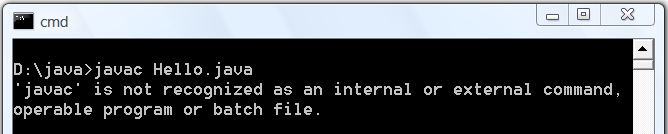
SYMPTOM: Cannot compile Java program from the CMD shell (e.g., "javac Howdy.java" does not work!) Mistake MESSAGE: 'javac' is non recognized as an internal or external command, operable program or batch file. Likely CAUSES: The PATH environment variable, which maintains a list of search paths for executable programs (including "javac.exe"), does non include JDK'southward bin directory. POSSIBLE SOLUTIONS: one) Showtime a CMD shell (click "Start" button ⇒ "run..." ⇒ enter "cmd") and outcome a path command: prompt> path PATH=....... two) Check if it includes your JDK's "bin" directory. For example, suppose that your JDK is installed in "c:\programme files\java\jdk-xv.0.one", then PATH should include "c:\programme files\coffee\jdk-15.0.1\bin". Otherwise, include JDK's bin directory in the PATH environment variable. Read "Pace 3 of How to install JDK". 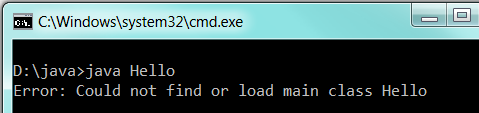
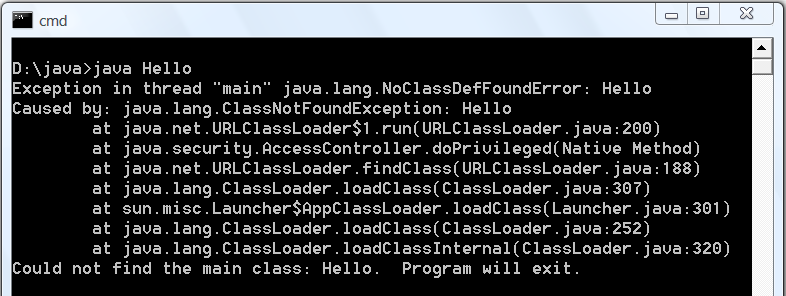
SYMPTOM: Tin can compile but cannot run Java program from the CMD shell (east.grand., "coffee Howdy" does not work!) ERROR MESSAGE (Post JDK 1.7): Error: Could non find or load main grade Xxx ERROR MESSAGE (Pre JDK 1.seven): Exception in thread "main" java.lang.NoClassDefFoundError: Xxx PROBABLE CAUSES: one) The Java class (in this instance, Hello.class) is Not in the current directory. 2) The CLASSPATH environment variable is fix, simply does not include the current directory ".". POSSIBLE SOLUTIONS: 1) Issue a "dir" command to list the contents of the current directory. Check that information technology contains the Java class to exist run (east.thou., Hello.form). You lot need to compile the source program (".java") to become the class file (".class"). two) If the Java grade is present in the current directory, result a "ready classpath" command to check its settings: prompt> set classpath CLASSPATH=....... If you lot receive the bulletin "Environment variable CLASSPATH non defined" and your program is right, I tin't assist you here. Otherwise, if the CLASSPATH is defined, for beginner, I suggest that you remove the CLASSPATH surround variable. From "Control Panel" ⇒ Organisation ⇒ (Vista but) Advanced system settings ⇒ Switch to "Advanced" tab ⇒ Environment Variables ⇒ Organization variables (and also User variables) ⇒ Select variable "CLASSPATH" ⇒ Delete (Delete from both the System variables and User variables) 3) (For Avant-garde Users Only) If CLASSPATH is non set, it is defaulted to the current directory. Nevertheless, if CLASSPATH is set, the current directory is Not implicitly included. You can include the current directory (denoted by a single dot ".") in front of the existing grade-paths. Read "Java Applications and Environment Variable" for more discussion on CLASSPATH.

SYMPTOM: Tin compile but cannot run the Hello-world program (due east.m., "coffee Hullo" does non piece of work!) ERROR Message (Post JDK one.vii): Fault: Chief method not plant in class Howdy. POSSIBLE SOLUTIONS: Check whether there is a main() method in your program, and the signature of your main() every bit shown in the fault message. (Advanced) External JAR Files and Native Libraries
Notes: This department is applicative to JDK prior to JDK 9. JDK ix introduces a new level called "module" on acme of package, and "jmod" files for Coffee modules. Need to revise this section for JDK 9.
External Java API packages (such every bit Servlet API, MySQL Connector/J, JOGL, JUnit) are often distributed in JAR files (Coffee Archive - a single-file packet of many Java classes similar to Goose egg or TAR), with possibly Native Libraries (".lib" and ".dll" in Windows, or ".a" and ".then" in Linux/macOS).
External JAR Files (".jar")
If external JAR files are not properly included:
- During the compilation, you volition receive compilation fault "cannot notice symbol" for classes belonging to the external packages.
- During execution, you volition get a runtime error "Could not find or load main class xxx" or "
NoClassDefFoundError".
To include external JAR files, yous can either:
- (Prior to JDK ix) Copy all the JAR files of the external packages to the Java'due south Extension Directories (Not applicable from JDK 9).
- For Windows, the JDK extension directory is located at "
<JAVA_HOME>\jre\lib\ext" (e.k., "c:\Program Files\Java\jdk1.eight.0_xx\jre\lib\ext"). - For macOS, the JDK extension directories are "
/Library/Java/Extensions" and "/Organisation/Library/Coffee/Extensions". - For Ubuntu, the JDK extension directories are "
<JAVA_HOME>/jre/lib/ext" (eastward.m., "/usr/user/java/jdk1.8.0_xx/jre/lib/ext") and "/usr/java/packages/lib/ext".
java.ext.dirs". You can print its contents viaSystem.out.println(System.getProperty("java.ext.dirs")). - For Windows, the JDK extension directory is located at "
- Yous can as well include all the JAR files in the
CLASSPATHenvironment variable.CLASSPATHmay contain directories (of Java classes) or JAR files (single-file annal of Java classes). If you set up theCLASSPATH, you must besides include the current directory (denoted as ".").- For Windows, ready the
CLASSPATHin Control Panel ⇒ Organization ⇒ Advanced system settings ⇒ Advanced ⇒ Surround Variables ⇒ System Variables ⇒ New ⇒ In "Variable name", enter "CLASSPATH" ⇒ In "Variable value", enter ".;path1\xxx.jar;path2\yyy.jar", where the entries are separated past a semi-colon (;). - For Linux and macOS: Edit
~/.profileor~/.bash_profile(or/etc/contourfor system-wide setting) to include the following line at the end of the file:export CLASSPATH=.:path1/xxx.jar:path2/yyy.jar
The entries are separated by colon (:).
- For Windows, ready the
- You can also set the
CLASSPATHin thejavac/coffeecommand-line via the option-cp <paths>(or-classpath <paths>), for example,javac -cp .;path1\30.jar;path2\yyy.jar ClassName.coffee java -cp .;path1\xxx.jar;path2\yyy.jar ClassName javac -cp .:path1/xxx.jar:path2/yyy.jar ClassName.java java -cp .:path1/xxx.jar:path2/yyy.jar ClassName
External Native Libraries (".lib", ".dll", ".a", ".then")
Some external package may provide static or shared native libraries in the form of ".lib" (Windows' static LIBrary), ".dll" (Windows' Dynamically Link Library), ".a" (Unix's static (Archive) library), or ".so" (Unix's Shared Object library).
Native Libraries are to exist kept in a directory attainable via JRE's Property "java.library.path", which ordinarily but non necessarily includes all the directories in the PATH environment variable.
Native libraries are not involved in the compilation. Merely if they are non properly included during runtime time, y'all volition go a runtime mistake "coffee.lang.UnsatisfiedLinkError: no xxx in java.library.path".
To include external native libraries:
- Copy the native libraries into a system library directory, e.m.,
c:\windows\system32(Windows),/usr/libor/usr/local/lib(macOS/Unix). You tin can verify that the directory is included in Coffee'southward System Property "coffee.library.path", viaSystem.out.println(System.getProperty("java.library.path")). - Y'all can also set the native library path via the
java's command-line option-Djava.library.path=thirty, for example,java -Djava.library.path=xxx ClassName
Eclipse/NetBeans
Using an IDE can profoundly simplifies inclusion of external packages. Read "Eclipse How-To" or "NetBeans How-To".
Link to References & Resource
DOWNLOAD HERE
Posted by: tinerbiles1977.blogspot.com

Post a Comment for "How To Download Java 8 Standard Edition On Mac UPDATED"